Regulatory Proposal Targets Prediction Markets
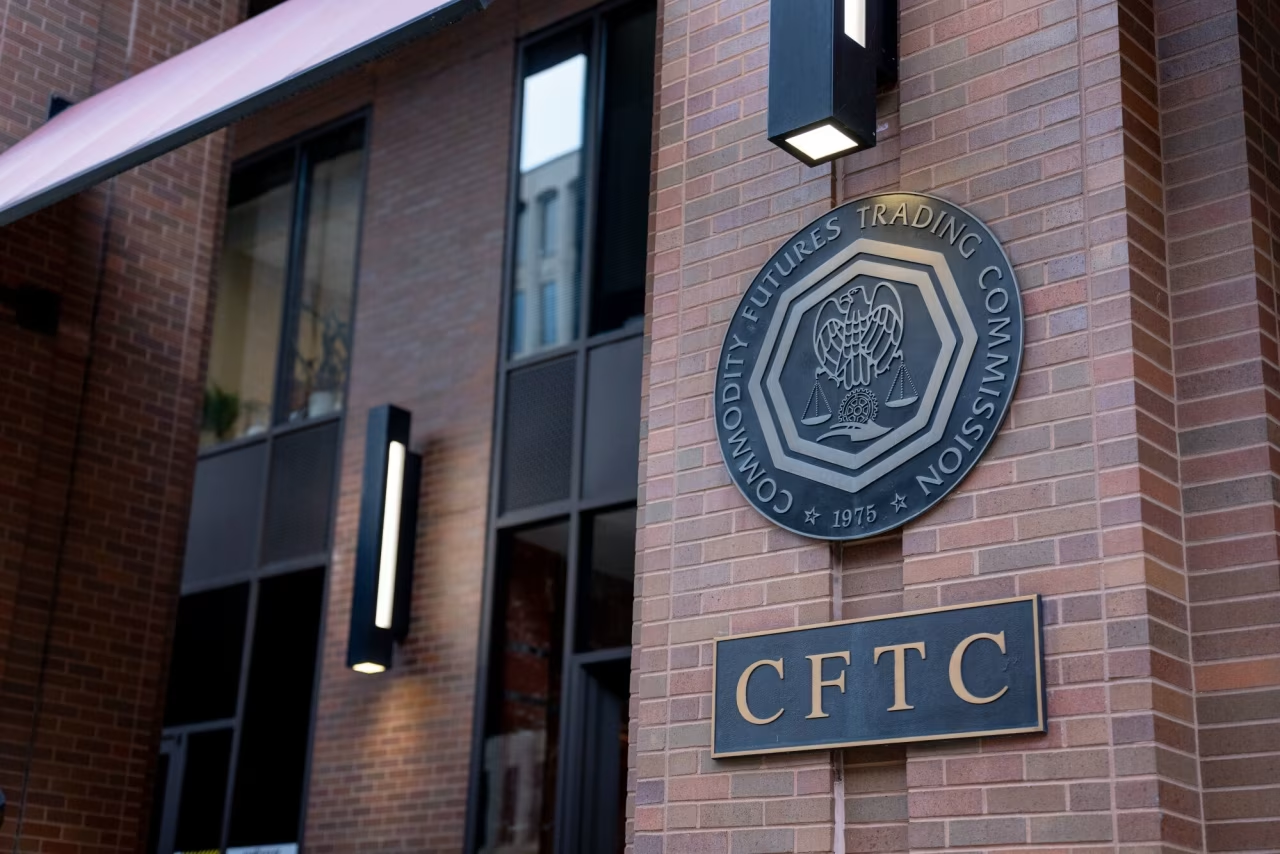
The Commodity Futures Trading Commission (CFTC) has put forward a proposal that would broaden the statutory definition of swaps to explicitly include prediction markets trading. Under the agency's current framework, swaps are broadly understood as financial instruments whose value is derived from an underlying asset, index, or event. The CFTC's move signals an intent to treat event-based contracts as a subset of that category, subjecting them to the same regulatory architecture already applied to traditional swap products.
Scope of the Expanded Definition
According to the CFTC, the expanded term would encompass event contracts linked to a range of outcomes, specifically sporting events, political events, cultural events, and weather-related events. In practical terms, this means that a contract in which a participant's payoff depends on, say, the result of an election, the score of a championship game, the outcome of an awards ceremony, or the temperature on a given day would fall within the regulatory perimeter the agency has designated for swaps.
By naming these four categories, the Commission is drawing a line around what it considers in-scope: discrete, observable events whose resolution can be verified against a public record. The proposal does not, as presented, extend to every conceivable form of speculative or derivative trading, but it does close what regulators have viewed as a gap in the existing taxonomy of financial instruments.
Implications for Market Participants
Bringing prediction market contracts under the swaps umbrella carries several practical consequences for firms that create, list, or facilitate such products. They would become subject to the reporting, record-keeping, and operational standards that the CFTC already imposes on swap dealers and major swap participants. Clearing, margin, and capital requirements that apply to other swap classes could, depending on how the final rule is written, extend to these event contracts as well.
For traders and platforms operating in the prediction markets space, the proposal represents a shift from a largely unclassified regulatory status to one with defined obligations. The CFTC's language makes clear that the agency views these instruments as sufficiently similar in economic function to traditional swaps to warrant uniform oversight, rather than a separate, bespoke regulatory regime.
Next Steps
As a proposal, the rule is not yet in effect. The CFTC's standard process would allow for a public comment period during which industry participants, consumer advocates, and other stakeholders can submit feedback before the agency finalizes its language. The timing and scope of any final rule will depend on the volume and nature of those comments, as well as the Commission's own deliberations.