
What the Clarity Act Was Supposed to Achieve
The Digital Asset Market Clarity Act has been shelved, at least for the time being, and the crypto community is reeling from what many see as a significant setback for the sector. Yet a surprising number of market participants never fully grasped what the bill actually contained. At its core, the legislation represented yet another iteration of a concept that has circulated through Washington for years: formally categorizing the various types of digital assets and precisely delineating which federal agency holds regulatory authority over each one.
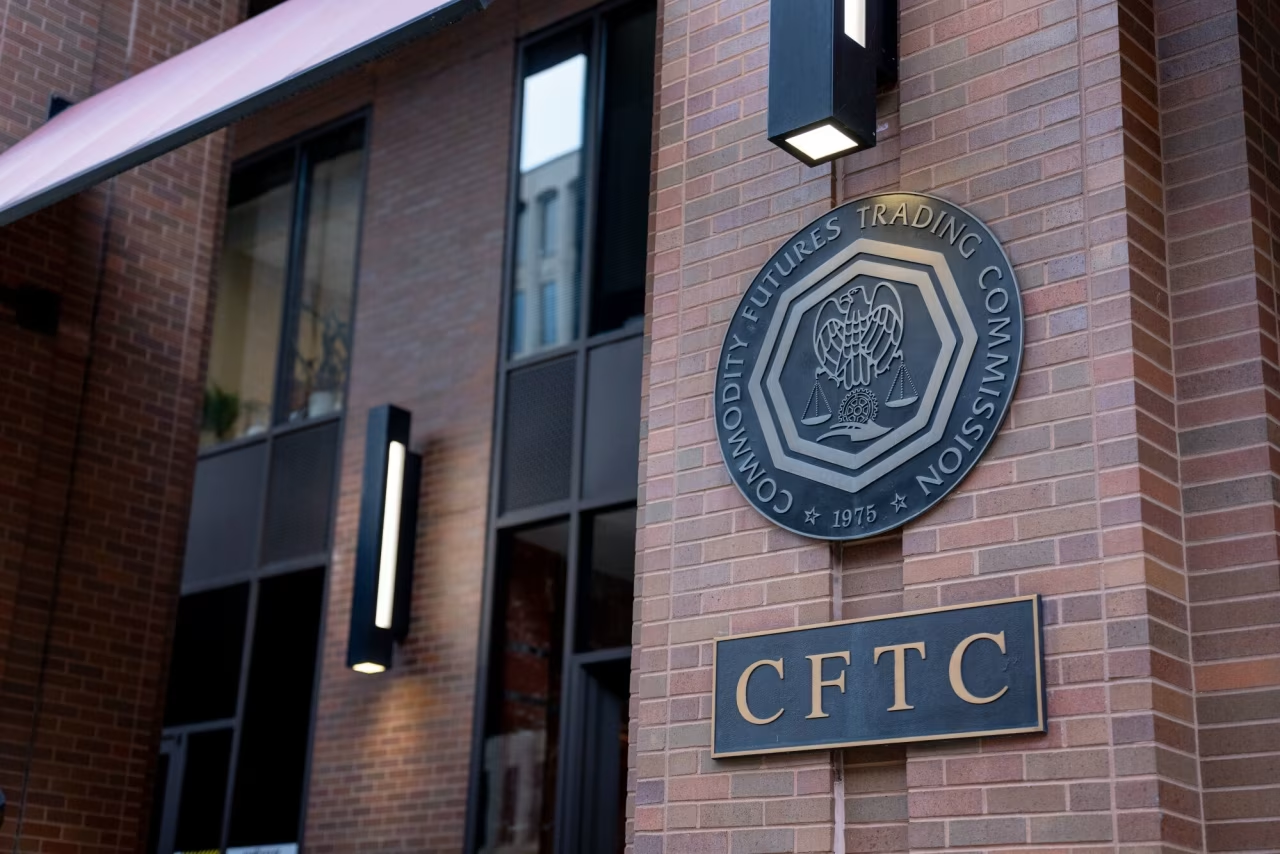
The bill would have granted the Commodity Futures Trading Commission — the SEC's counterpart in derivatives oversight — sweeping new powers, most notably full supervisory jurisdiction over spot markets for crypto commodities. Spot markets are the venues where assets are traded directly for immediate settlement, a domain that has long sat in a gray zone since bitcoin first emerged. The Act also included provisions aimed at tightening controls on illicit finance and, in a particularly contentious provision, offered limited legal shields to software developers working in decentralized finance so they would not face prosecution simply because third parties used their open-source tools in unintended ways.
A Regulatory Tug-of-War Uniquely American
The confusion over who governs what in the crypto space is, by and large, an American problem. The United States built its financial regulatory architecture around two entirely separate agencies — one for securities, one for derivatives and commodities — rather than the unified oversight models found in much of the rest of the world. That structural split turned every new digital asset into a jurisdictional minefield from the very beginning.
For years, the industry found itself locked in a bitter standoff with the SEC over fundamental questions: Could platforms like Coinbase and Kraken lawfully list certain tokens? Did issuing a cryptocurrency amount to offering a security? The disputes escalated into a wave of enforcement actions, multimillion-dollar settlements, and public drama, much of it directed by former SEC Chairman Gary Gensler — a figure who still draws sharp criticism from crypto insiders. The Clarity Act was meant to put that era of uncertainty to rest by drawing clear lines in the sand.
Critically, the provisions that ultimately derailed the bill in Congress had very little to do with the legislation's central regulatory mission. Rather than dissecting those political landmines, the more pressing question now is what fills the void the Act leaves behind.
SEC and CFTC Step Into the Gap
The answer, it turns out, did not require a long wait. SEC Chairman Paul Atkins — a nominee hand-selected by President Donald Trump — entered his role with digital-asset rulemaking squarely on his agenda. Just two days after the Clarity Act's defeat became clear, Atkins advanced a major policy initiative to create a formal regulatory pathway for tokenized securities, a centerpiece of the agency's new crypto strategy.
That move, however, was only one thread in a broader tapestry. Atkins and CFTC Chairman Mike Selig — who previously served as a crypto-focused official within Atkins' own SEC office — had already launched a joint digital-assets campaign. A key early deliverable was a proposed "taxonomy": a set of standards defining how different categories of digital assets should be treated under existing rules. These staff-level policy projects have offered the industry a degree of clarity, but they rest on fragile ground because a future administration could simply reverse them.
Ian Katz, a policy analyst at Capital Alpha, noted that the Republican leadership at both agencies is now positioned to "shift into overdrive with aggressive, pro-industry proposals." In a client note following the Clarity Act's failure, he added that those leaders "will be able to pass regulations without Democratic approval" and that some proposals may carry an implicit message to congressional Democrats: this is the consequence of failing to legislate.
On the CFTC side, Selig — who is currently the sole active member of the agency's five-seat commission and thus able to act unilaterally — sent a proposal covering crypto transactions and markets to the White House for review. The CFTC has already begun drafting rules for prediction markets, recently opened the door to crypto perpetual futures (commonly called "perps"), and is exploring a new designation for firms that would function as a "crypto asset market," analogous to the agency's existing category of designated contract markets.
Durability and the Road Ahead
Taken together, the SEC and CFTC now have a slate of projects that collectively approximate a piecemeal version of what the Clarity Act would have established in statute. But the foundation is shaky. Because these rules are issued under existing agency authority rather than congressional law, they are more exposed to legal challenges and far easier for a future Democratic-appointed commission to unwind. The SEC's own tokenization initiative, Atkins has suggested, is partly a rehearsal designed to inform a more durable, legally anchored policy — or a successor to the Clarity Act itself.
Atkins has been vocal about the limitations of what his agency can deliver alone. In August, he stated that legislation "remains indispensable" for creating rules of the road durable enough to withstand what he called a "future rogue regulator." He has reiterated in speeches across the past two years that only Congress can truly future-proof regulation in this space. At the same time, he has emphasized that the SEC intends to be a constructive partner: when he unveiled Project Crypto in November, he described it as a framework that "aligns with legislation currently being considered by Congress and aims to complement, not replace, Congress's critical work."
For now, though, that legislative complement has not materialized. Project Crypto stands on its own, and the industry must navigate a regulatory landscape built on agency rules that lack the permanence of statute — a situation that leaves both investors and developers with more questions than answers about how stable the ground beneath them truly is.