Futures Client Balances Surpass the Retail Forex Total
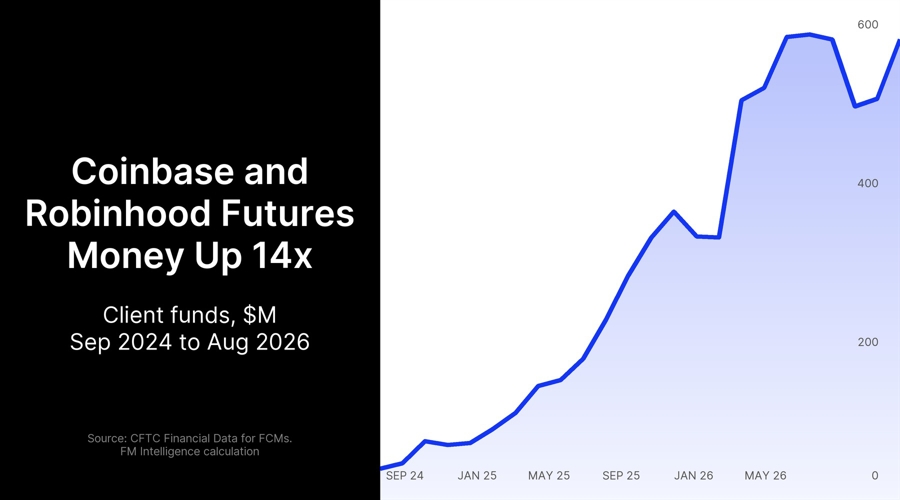
A new analysis by FM Intelligence of monthly filings with the Commodity Futures Trading Commission reveals a striking shift in the US derivatives landscape. At the close of August, the futures commission merchants behind Coinbase and Robinhood collectively held $581.4 million in segregated client money. That figure exceeds the $470 million in client balances owed by all six registered US retail forex dealers during the same period.
The growth trajectory has been steep. Just two years before the August snapshot, the two firms' FCMs managed a combined $40.3 million in client funds, according to FM Intelligence calculations drawn from CFTC records. Coinbase Financial Markets alone held $346.9 million in August, while Robinhood Derivatives accounted for $234.5 million. The pair's combined balances first eclipsed the total retail forex figure back in January 2026.
The data comes from a 24-month review of CFTC FCM filings running through August 2026. It is important to note a structural distinction: FCM balances encompass every futures client at those firms, not solely crypto traders, whereas the forex figure captures retail clients only. The comparison therefore gauges the relative scale of each licensed distribution channel rather than a like-for-like product match.
CFTC Framework Directs Retail Crypto Leverage Toward FCMs
The regulatory backdrop explains much of the migration. On October 5, the CFTC published an advance notice outlining a proposed retail crypto framework. Under that plan, leveraged purchases of crypto assets by retail investors would be permitted only through FCMs or the banks they sponsor. Broker licenses issued by Cyprus, the United Kingdom, or Australia do not qualify under the proposed regime.
The agency has already demonstrated its enforcement appetite on this front. In June, the CFTC assessed a $2.5 million penalty against two firms operating a white-label arrangement that allowed offshore brands to extend leveraged trading to US retail customers.
The regulatory package is structured in two components: Regulation Crypto Asset Transactions and Regulation Crypto Asset Markets. Notably, it does not prescribe a specific leverage ratio. Instead, it poses the question of whether margin requirements should be set by clearing houses or delegated to the National Futures Association, the model currently applied to forex dealers, whose 50:1 cap on major currency pairs has been in place since 2010.
CFTC Chairman Michael Selig framed the agency's intent, stating that the regulator seeks rules designed to prevent fraudulent schemes rather than merely prosecuting them after the fact, citing the collapse of FTX as a cautionary example.
Kraken and NinjaTrader Add Further Weight to the Futures Side
The futures segment's dominance is reinforced by additional platform ownership. Kraken controls two FCMs, including NinjaTrader Clearing, which it acquired alongside NinjaTrader in a $1.5 billion deal completed in 2025. NinjaTrader Clearing held $586.5 million in client balances and serves as the clearing vehicle for Kraken's US perpetual futures. Even before the Kraken acquisition, NinjaTrader had already managed $281.5 million in client funds as of September 2024.
On the forex side, the picture points in the opposite direction. Finance Magnates reported in August that client balances at the registered dealers continued to decline throughout the first half of the year. At $470 million, the total now sits 15 percent below the level recorded in August 2015. Two firms, Gain Capital and OANDA, account for 71 percent of the remaining retail forex client balances.
Leverage Gaps and What Comes Next
Current leverage offerings in the US already run materially higher than European equivalents. FM Intelligence identified a similar disparity for single-stock perpetual contracts in September. Coinbase lists perpetual-style bitcoin futures with up to 10 times leverage, and Robinhood has announced the same maximum. By contrast, the European Securities and Markets Authority informed firms in February that perpetual futures likely fall within the scope of EU CFD regulations, which cap crypto leverage at 2:1.
Stakeholders have until December 14 to submit comments on the CFTC's advance notice. The full FM Intelligence analysis extends its projections to August 2027, modeling where platform-owned segregated balances could reach, and also details the prices buyers have paid for CFTC licenses since 2021.