Trump's Ultimatum and the Camp David Gathering
Seven months into the conflict, the Iran narrative has cycled through a predictable pattern: Tehran tabled demands, Washington shot them down, a tanker went up in flames, crude held near $100, and a modest cooling-off period followed before the next round. This weekend, however, the rhythm broke. Nearly every variable shifted simultaneously, and the president made explicit that a choice is pending.
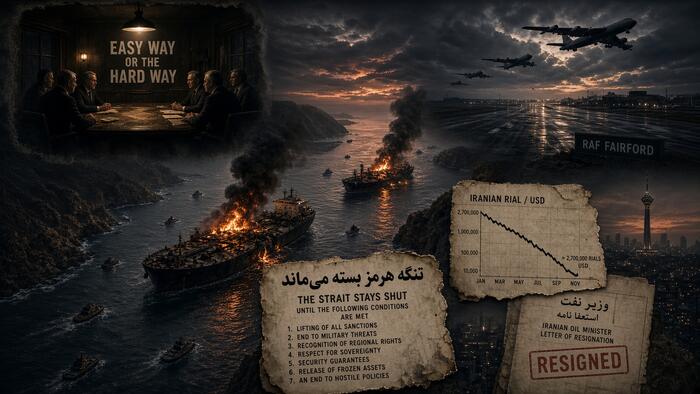
Speaking to reporters outside the White House on Saturday, Trump stated that the situation in Iran has been "decimated" and that the only remaining question is whether resolution will come through what he called the easy path or the hard one. Pressed for specifics, he offered the familiar deflection: "If I told you, you'd have a major story, right? But you'll see."
The cryptic remark gains context from what was confirmed by CBS News: the administration's full Iran policy team convened at Camp David. The roster included Vice President JD Vance, Secretary of State Marco Rubio, Defense Secretary Pete Hegseth, special envoy Steve Witkoff, CIA Director John Ratcliffe, and Joint Chiefs Chairman General Dan Caine. Axios broke the story first, noting that Vance chaired the unannounced session. Two topics dominated the agenda—the ongoing Iran war and the escalating Saudi-Houthi conflict in Yemen, which is now threatening global oil shipping lanes. The White House has not disclosed any decisions. A source familiar with the meeting told Axios that matters were "decided or at least deeply discussed." Notably, the previous time this particular group assembled in the Maryland highlands for an Iran discussion was June 2025, a gathering that was followed, among other things, by B-2 bomber sorties.
Military Build-Up, Tanker Strikes, and the Yemen Front
Regardless of what was settled at Camp David, the military posture is shifting. The USS Theodore Roosevelt carrier strike group and the USS Makin Island amphibious assault group are en route to the Middle East, carrying roughly 7,000 sailors and 2,000 Marines, with arrival expected by the end of October. Bloomberg observes that this deployment could place three US carrier strike groups in the region—a concentration of naval power last seen during the opening phase of the 2003 Iraq invasion. Defense Secretary Hegseth described the US maritime blockade of Iranian ports as "ironclad."
Trump had been dropping veiled warnings for days, telling reporters that "you will see things happening very soon" and citing what he characterized as historic oil flows out of Hormuz in the preceding three days. On timing, he told TIME last week that heavier strikes remain "possible" after the November 3 midterms. Bloomberg reports that Iranian officials themselves assess the probability of a deal before that vote as slim and the risk of post-election escalation as high, suggesting "decision week" could stretch into "decision month."
On the UK side, the Pentagon confirmed on Sunday that all twelve B-1B bombers deployed to RAF Fairford—aircraft used in strikes against Iran—have returned to their home bases in the continental US. The WSJ first reported the redeployment, which came roughly a week after several men were arrested near the base on suspicion of planning terrorist acts. UK Prime Minister Andy Burnham stated on Wednesday that Britain holds "strong indications" of Iranian involvement. US intelligence describes an IRGC-linked handler who recruited British citizens for a multi-stage operation beginning with a diversion near the base. Trump said the plotters had planned "big damage," while Rubio attributed the scheme to "the hands of a foreign actor." Tehran dismissed the allegations as baseless and summoned the British ambassador. Five British suspects, along with a sixth individual holding dual British-Iranian citizenship who was detained in London, have all since been released on bail. Some UK officials have privately questioned whether the plot was as sophisticated as US accounts suggest.
The Pentagon maintains that relocating the bombers does not diminish long-range strike capability—B-1s can reach Iran from the US with aerial refueling, albeit with considerably longer flight times. On the water, the violence continued. UKMTO reported on Sunday that two additional tankers were struck by unidentified projectiles. One, inside the Strait of Hormuz, sustained engine-room damage; the other, a crude carrier about four nautical miles east of Oman, was hit on its port side. All crew members were accounted for and no environmental damage was reported. By SBS's tally, that brings the October incident count to at least four. The first was the 2.5-million-barrel supertanker set ablaze off Oman on Thursday, which Iran's Fars news agency said had been transiting an "unauthorized" route.
UKMTO's latest weekly report logs 91 vessel-damage incidents since February. Since July 6, 31 of 48 projectile strikes have occurred along the southern Omani corridor—the US-facilitated shipping lane that much of recovering Gulf traffic now relies upon.
A second front ignited on Sunday when Yemen's Saudi-backed government launched a major offensive to retake all Houthi-held territory. Presidential Leadership Council head Rashad al-Alimi vowed to fight "until the country is liberated from the grip of the terrorist militia." Reuters reports that Saudi Arabia is leading the air campaign while Yemeni forces engage on the ground, with the US providing intelligence support. The stakes are heavily tied to oil: last month's Houthi offensive captured the Bab el-Mandeb strait and approximately 150 kilometers of Red Sea coastline—the very bypass route Riyadh has used to move crude without transiting Hormuz. On Sunday, the Houthis claimed missile and drone strikes on Saudi Aramco facilities in Riyadh and Khurais, alleging major fires. Riyadh has not confirmed the claims.
Diplomatic Deadlock and Iran's Economic Squeeze
Hours before the latest tanker strikes, Iran restated its negotiating position. Parliament speaker and chief negotiator Mohammad Baqer Qalibaf reiterated the seven conditions Tehran laid out in September: lifting the maritime blockade, restoring frozen Iranian assets, removing sanctions on oil exports, halting all US actions framed as threat responses, ending the war against Iran and its regional allies, withdrawing US forces from border areas, and paying compensation for war damage while committing not to interfere with Iran's nuclear and missile programs. In essence, Tehran is asking for every concession plus reparations. It is no surprise that Trump "promptly rejected" a seven-day reopening framework built on those terms.
Foreign Ministry spokesman Esmaeil Baghaei said the US counter-proposal, relayed through Qatar, is "more or less in line with their previous positions, specifically on the nuclear issue." He emphasized that Tehran's current focus is the Strait of Hormuz and denied reports that Iran had offered UN inspections in exchange for sanctions relief. One official briefed on the talks told Reuters the core dispute concerns the sequencing of steps rather than their substance. Foreign Minister Abbas Araqchi warned that if the US "again move[s] towards military solutions, we are more prepared than before."
The irony is that the strait Iran claims to be keeping closed is, in practice, increasingly open to everyone except Iran itself. Goldman's commodity strategists estimate that Persian Gulf oil exports, including "dark exports," have effectively recovered to their 2025 average, with Saudi Arabia leading the rebound while Iran's output has fallen below 20 percent of its 2025 level. In this weekend's client note, Struyven, co-head of Goldman's global commodities research, pegged the latest figure at 23.6 million barrels per day, of which roughly 4 mb/d is estimated dark exports. He added that the data show no seaborne crude exports from Iran in September. JPMorgan, cited by Bloomberg, puts Middle East crude shipments at 17.5 mb/d, or 98 percent of pre-war levels. Bloomberg tanker tracking shows Saudi crude exports jumping from 3.4 mb/d in August to roughly 6.1 mb/d in September.
Treasury Secretary Scott Bessent kept score in prior remarks: US barrels out of the Strait number about 1.1 billion, while Iran's are zero. "For the first time in history… they will have no oil on the water this week. They will have no revenue," he said.
The resignation of Iran's oil minister, Mohsen Paknejad, announced Sunday, punctuated the economic pressure. State media attributed the departure to "personal" reasons. Hamid Bovard, chief executive of the National Iranian Oil Company, has been named acting minister. Mehdi Tabatabaei, communications deputy in the president's office, told state television that Paknejad had resigned "a long time ago" and that President Pezeshkian accepted it at the minister's insistence. The timing is striking: just hours before the news broke, Paknejad was quoted by state media insisting that revenues from previously sold oil are "still coming and that will continue, God willing." When an oil minister invokes divine intervention for cash flow, the cash flow is likely in serious trouble.
The sharpest economic indicator is the currency. On the open market, the rial has slid to a record low of approximately 2.7 million per dollar, and the euro surpassed 3 million rials for the first time, according to Iran International. This occurred despite a central bank plan to inject $2 billion in banknotes, with the initial $1 billion sold through banks at a cap of $10,000 per ID holder. Official year-over-year inflation has reached a record 89.8 percent—though actual rates are widely believed to be higher—and the monthly minimum wage of 166 million rials translates to roughly $66. Bloomberg calculates the rial has lost about 25 percent against the dollar over the past two months alone. Bessent interprets the collapse as evidence the sanctions campaign is working. Economy Minister Ali Madanizadeh counters that "predictions of collapse repeatedly proved wrong" and blames "psychological pressure." Both readings may hold simultaneously, which is what makes Tehran's next move so difficult to predict.
Bader Al-Saif of Kuwait University, speaking to Bloomberg, captured the dilemma: "Everyone has a breaking point, and Iran is no exception… The irony is that such pressure can yield opposing responses: concessions or a preemptive strike."
Oil Market Positioning and the Road Ahead
Oil markets reacted swiftly. Brent rose 81 cents to $103.06 in early Asian trading on Monday, while WTI climbed to $91.57. December Brent had already gained nearly 5 percent the prior week, even though OPEC+ agreed to hold November quotas steady and the G7 announced a release of up to 100 million barrels of emergency oil and diesel. The world's largest crude exporter is now engaged in a ground war on its southern border while its Gulf coast exports transit a strait it does not control—a combination that argues against cheaper oil.
Goldman's desk places the current risk premium at $20–25 per barrel. Strategist Thomas Evans noted in Sunday's Weekly Commodity Thoughts that, for the first time in this conflict, speculators are buying outright delta rather than calls: "Many macro books are structured to perform if the crisis eases but bleed badly if oil spikes toward $130—effectively short oil in the tail." In other words, a significant slice of the macro community is positioned for the "easy way." That positioning matters when a president keeps referencing "the hard way."
On the research side, Struyven is holding to Goldman's base case that Brent moderates to $85 per barrel by year-end and to $80 in 2027, while cautioning that "we still worry about renewed potential escalation that damages more energy infrastructure, which could cause significant upside to prices." Co-head Sam Dart highlights that LNG recovery lags far behind oil: Hormuz LNG crossings are running at only 21 percent of pre-war levels, and if Gulf LNG exports remain stuck near 25 percent through winter, Goldman estimates European TTF gas would need to rise above €100 per megawatt-hour.
Bloomberg's own analysis notes that global stockpiles of roughly 4.3 billion barrels have fallen more than 400 million barrels since March, per Energy Aspects, marking a five-year low. Tanker rates for the Persian Gulf-to-China run top $1.2 million per day. With bond yields at 2002 highs, traders are once again using oil as an inflation hedge. BofA's economists, in their Global Economic Weekly, summed up the mood: "oil flows are normalizing in the Middle East, but Brent keeps trading above $100 per barrel… Something does not add up."
BofA's commodity team raised its second-half-2026 Brent baseline to $95 (from $83) on the view that "skirmishes seem likely to continue into yearend." Its scenario tree maps neatly onto Trump's binary framing. Brent at roughly $103 is pricing something between "skirmishes" and "combat"—precisely where the Camp David attendees appear to be operating.
Chatham House associate fellow Aniseh Bassiri Tabrizi offered perhaps the clearest summary of the standoff: "Both sides generally want an agreement, but they are moving further apart rather than closer." Iran's leverage over Hormuz is fading, its currency is in freefall, and its oil minister has walked out the door. That combination makes the "easy way" more probable and the "hard way" considerably more dangerous. As one former US intelligence official told Bloomberg, Tehran's hardliners "are betting that they can absorb more domestic pain and wait out US engagement in the region."
The oil market, which entered this war with full tanks and ample spare capacity, now possesses neither. If Trump selects door number two, the current risk premium will look inexpensive by comparison. The answer, as the president put it, is coming. "You'll see."