
A Record Escort Operation and a Fragile Calm in the Strait
Brent crude futures drifted lower toward the $103 mark per barrel as the trading week closed, with a mix of contradictory signals from Tehran and cautious optimism surrounding potential diplomatic engagement at next week's United Nations General Assembly keeping energy traders on edge.
The backdrop for that modest price relief was a striking announcement from US Central Command. On Saturday morning, CENTCOM's top officer, Admiral Brad Cooper, disclosed that American naval forces had guided roughly one billion barrels of crude oil and more than two thousand commercial ships safely out of the Persian Gulf over the preceding two-month stretch. The figure underscores just how much of the region's energy lifeline now depends on military protection as the chokepoint remains a flashpoint.
The danger at the strait showed no signs of abating. CBS News reported on Friday that two vessels came under fire from projectiles while transiting the waterway. Iranian authorities took credit for at least one of the incidents, framing it as a response to an "unlawful transit" of the passage.
Washington Weighs a Major Escalation
The diplomatic and military stakes have risen sharply. Speaking on Thursday, President Donald Trump told Axios that he was close to making what he called a "large decision" about whether to order a sweeping military operation aimed at dismantling the Iranian government. "It is a big decision," he said, adding pointedly, "anything could happen to me." The remarks came ahead of a scheduled gathering with Gulf Cooperation Council leaders planned for the following Tuesday.
Market watchers at ZeroHedge speculated that any large-scale strike against Tehran — whether it takes the form of a kinetic assault, a campaign to capture or neutralize Kharg Island, or a second wave of broadened sanctions that could sweep in Beijing alongside Tehran — may be deliberately timed to land after the US midterm elections. The timing question adds a layer of uncertainty that traders are pricing in even as daily headlines shift.
Export Flows Hold Up, but the Deficit Is Significant
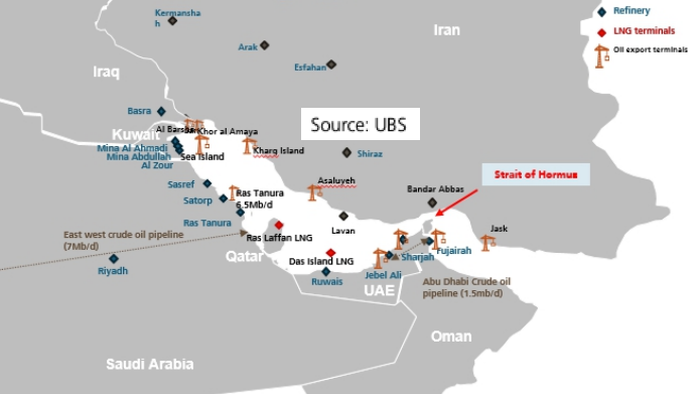
Despite the disruption to Saudi Arabia's East-West pipeline, Middle East oil exports have proved more resilient than many expected. The key reason, noted by JPMorgan's head of global markets strategy Dubravko Lakos-Bujas in a client note, is that a substantial share of volumes has been rerouted through the Strait of Hormuz itself.
UBS oil and gas analyst Henri Patricot provided a detailed breakdown. He estimated that combined crude and refined-product exports via the strait and alternative bypass routes climbed to approximately 14 million barrels per day in the two trading days immediately before Friday. On a weekly average, total flows stood near 12 million barrels per day — well below the more than 20 million barrels per day that had been moving through the region before the conflict erupted in late February.
That gap translates into a weekly shortfall of over eight million barrels from these export corridors. The magnitude of the disruption becomes especially acute as Northern Hemisphere winter approaches. Saudi Arabia has already notified major European refineries that crude loadings will be suspended next month because the East-West pipeline remains impaired.
Patricot attributed the recent uptick in Hormuz transits largely to what he termed "dark transits" — shipments that do not appear in publicly available AIS tracking data. He also flagged that Aramco is expected to increase exports routed through Oman over the coming weeks, with the barrels directed primarily to Asian buyers. Meanwhile, a second LNG carrier exited the Gulf within the month, and traffic through the Bab el-Mandeb Strait has stayed within its recent operating range.
Loadings Data and the Diesel Squeeze
Gulf crude loadings excluding Iranian volumes surged past 10 million barrels per day over the last two days, approaching the highest level recorded since the conflict began. The weekly average for the most recent seven days was 8.1 million barrels per day, compared with an August average of 5.5 million. The lift was driven by higher Saudi and Iraqi export volumes. Iranian crude, by contrast, has yet to reappear in loading statistics.
On the bypass routes, which include the Fujairah hub, loadings averaged 2.5 million barrels per day over the past two days. For September to date, the figure stands at 4.9 million barrels per day, up from 3.4 million in August and well below the 6.4 million recorded in July. Refined-product loadings in the Gulf have also recovered modestly, climbing above 1.5 million barrels per day after spending most of the conflict period below the one-million mark.
On the pricing side, Brent settled at roughly $103.87 per barrel on Friday. More telling for downstream consumers was the US diesel crack spread, which closed near $112.60 per barrel — a signal that the acute pain in the current energy crisis is concentrated less in the crude segment and more in the refining and distillation chain, with diesel bearing the brunt of the tightness.